

2026 Salary Research
Tree Removal Worker Salary in 2026: Research and Data-Backed Facts
A practical look at U.S. tree worker pay, hourly wages, state comparisons, specialized roles and the employment outlook—based on the latest available federal and market data.
Tree removal can be physically demanding, highly skilled and potentially dangerous work. Workers may spend their days climbing large trees, handling chainsaws, operating bucket trucks, rigging heavy limbs, feeding brush into chippers and working around buildings, roads or utility lines.
Because the term “tree removal worker” can describe several different jobs, there is no single federal occupation officially named “tree removal worker.” The closest and most useful government benchmark is the U.S. Bureau of Labor Statistics occupation Tree Trimmers and Pruners, SOC 37-3013.
This occupational category covers much of the work performed by tree trimmers, tree climbers, arboriculture workers and employees performing pruning and tree-removal-related tasks.
According to the latest BLS wage data available for 2026, the median tree trimmer and pruner earns $50,960 per year, or $24.50 per hour. The mean wage is higher, at approximately $55,970 annually or $26.91 per hour.
The difference between the median and average matters. The median represents the worker in the middle of the wage distribution, while the mean can be pulled upward by highly paid climbers, supervisors and specialized employees.
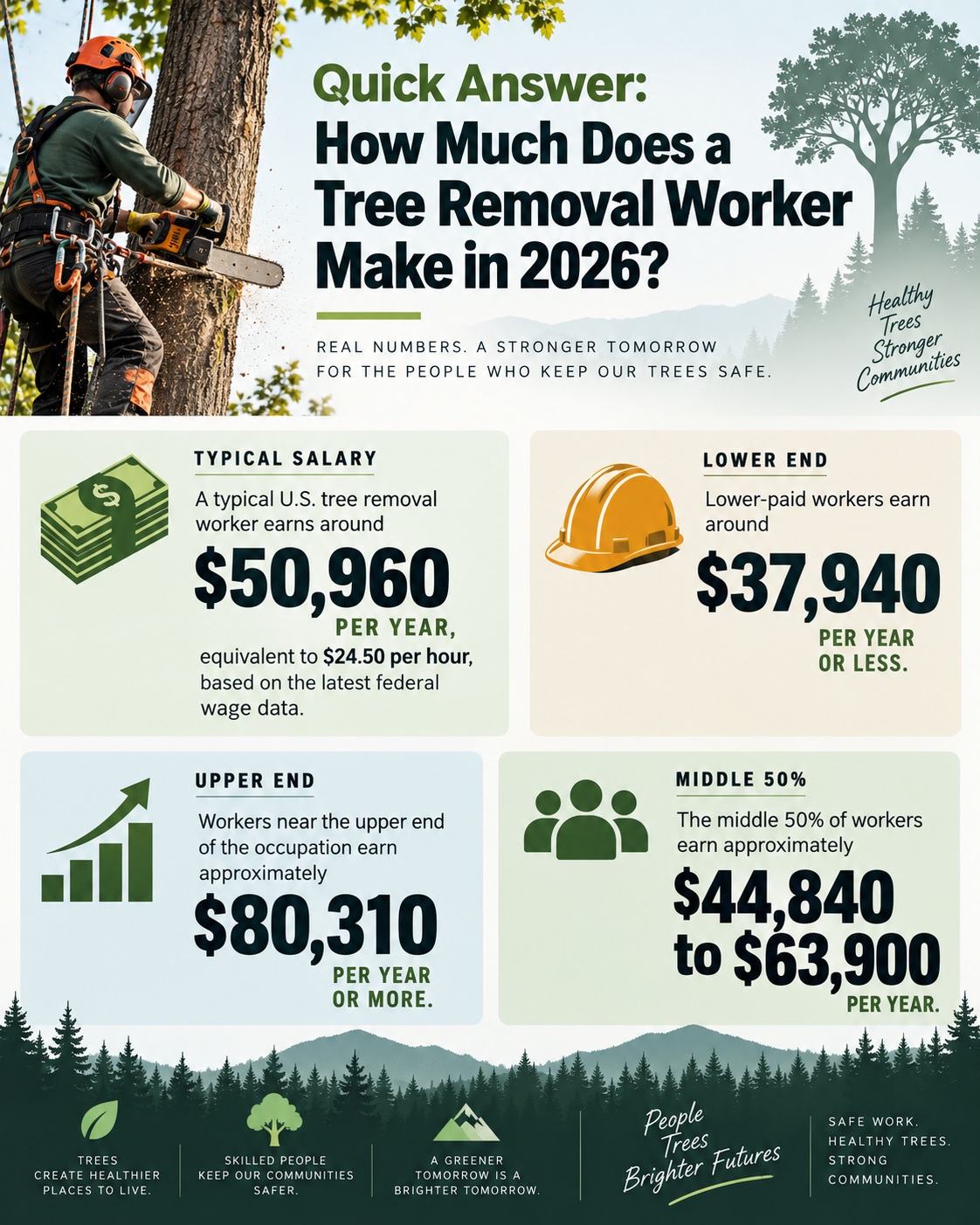
Quick Answer: How Much Does a Tree Removal Worker Make in 2026?
A typical U.S. tree removal worker earns around $50,960 per year, equivalent to $24.50 per hour, based on the latest federal wage data.
Lower-paid workers earn around $37,940 per year or less, while workers near the upper end of the occupation earn approximately $80,310 per year or more.
The middle 50% of workers earn approximately $44,840 to $63,900 per year.
A worker earning the national median would make approximately:
| Pay period | Median earnings |
|---|---|
| Hourly | $24.50 |
| Daily at 8 hours | $196 |
| Weekly at 40 hours | $980 |
| Monthly equivalent | $4,247 |
| Annual | $50,960 |
These figures represent base wage equivalents. Actual take-home pay can differ because of overtime, bonuses, seasonal hours, benefits, taxes and other compensation.
Tree Removal Worker Salary Statistics for 2026
The May 2025 BLS Occupational Employment and Wage Statistics dataset is the latest complete federal occupational wage dataset available for a 2026 salary analysis.
| Salary level | Hourly pay | Annual pay |
|---|---|---|
| Bottom 10% | $18.24 | $37,940 |
| 25th percentile | $21.56 | $44,840 |
| Median | $24.50 | $50,960 |
| Mean/Average | $26.91 | $55,970 |
| 75th percentile | $30.72 | $63,900 |
| Top 10% | $38.61 | $80,310 |
Federal wage data confirms the national median at $24.50 an hour and $50,960 annually. The lowest 10% earn $37,940 or less, while the highest 10% earn $80,310 or more.
What Do These Salary Percentiles Mean?
Salary percentiles should not be interpreted as exact experience levels.
For example, being in the bottom 25% does not automatically mean someone is an entry-level employee, and earning in the top 10% does not necessarily mean the worker has a specific number of years of experience.
However, the wage distribution provides a useful approximation of how compensation may progress.
A newer grounds worker or employee performing less-specialized tree work may fall closer to the $37,940–$44,840 range.
A worker near the middle of the occupation earns around $50,960 annually.
Experienced climbers, equipment operators, foremen and specialized arboriculture workers may earn $63,900 or more.
Workers in the highest-paid part of the occupation can exceed $80,000 annually, particularly in higher-paying markets or specialized positions.
Tree Removal Salary by Job Title
“Tree removal worker” is an umbrella term rather than one standardized job title.
A tree service company may employ ground workers, climbers, certified arborists, bucket operators, equipment operators, crew leaders and supervisors. Each position carries different levels of responsibility, risk and required expertise.
Here is how several related job titles compare.
| Job title/source | Hourly pay | Approx. annual pay |
|---|---|---|
| Tree trimmer/pruner – BLS median | $24.50 | $50,960 |
| Tree trimmer/pruner – BLS mean | $26.91 | $55,970 |
| Arborist – Indeed average | $27.13 | ~$56,430* |
| Tree climber – Indeed average | $28.52 | ~$59,322* |
| Tree climber – ZipRecruiter | $24.81 | $51,611 |
| Tree service supervisor – ZipRecruiter | $33.64 | $69,971 |
| Tree trimming worker – ZipRecruiter | $25.44 | $52,920 |
| Bucket operator – ZipRecruiter | $20.34 | $42,306 |
*Annual equivalents calculated using 2,080 working hours per year.
Salary websites are continuously updated, so these figures should be treated as current market estimates rather than permanent benchmarks.
Arborist Salary in 2026
Indeed reported an average U.S. arborist wage of approximately $27.13 per hour as of August 30, 2026.
The reported range was approximately $18.25 to $40.34 per hour, based on roughly 1,900 salary observations collected from job postings during the previous 36 months.
At $27.13 per hour, a full-time worker working 2,080 hours would earn approximately $56,430 per year before overtime or additional compensation.
Arborist positions can also differ substantially from general tree removal jobs. Some arborists specialize in tree health, disease identification, pruning plans, risk assessment or consulting rather than performing removal work exclusively.
Tree Climber Salary in 2026
Tree climbing is one of the more specialized positions within the tree-care industry.
Indeed’s August 2026 data puts the average U.S. tree climber wage at approximately $28.52 per hour.
Its observed salary range runs from approximately $20.41 to $39.87 per hour, based on around 4,000 salary observations from job postings.
At $28.52 per hour, that translates to approximately $59,322 per year at 2,080 hours.
ZipRecruiter provides another useful benchmark. As of August 22, 2026, it estimated average tree climber compensation at:
$24.81 per hour
$51,611 per year
$992 per week
$4,300 per month
ZipRecruiter reported that most tree climber salaries fall between approximately $42,500 and $58,500 per year, while top earners near the 90th percentile make around $68,000 annually.
Differences between Indeed, ZipRecruiter and BLS estimates are normal. Each source uses a different methodology and data pool.
Tree Service Supervisor Salary
Moving from hands-on tree work into crew leadership or supervision can significantly increase earning potential.
ZipRecruiter estimated the average Tree Service Supervisor salary at approximately $69,971 per year, equivalent to $33.64 per hour, as of August 2026.
The majority of salaries were estimated between approximately $52,000 and $80,500 annually, while the highest-paid workers could exceed $100,000.
Supervisors may be responsible for crew scheduling, job-site safety, equipment management, customer communication, estimating jobs and ensuring work is completed according to company and safety standards.
That additional responsibility helps explain why supervisory compensation can exceed standard tree-worker pay.
Highest-Paying States for Tree Removal Workers in 2026
Location can have a major impact on earnings.
The latest BLS-based state wage figures show substantial differences between states.
| State | Median hourly wage | Median annual salary |
|---|---|---|
| Minnesota | $37.24 | $77,460 |
| Oregon | $36.27 | $75,440 |
| New Jersey | $34.59 | $71,940 |
| Illinois | $30.99 | $64,450 |
| Washington | $30.70 | $63,850 |
| California | $30.07 | $62,550 |
| Massachusetts | $30.07 | $62,550 |
| New York | $30.00 | $62,400 |
| Vermont | $29.89 | $62,170 |
| Missouri | $29.40 | $61,140 |
Minnesota has the highest reported state median at $77,460 per year, approximately 52% above the national median of $50,960.
Oregon follows at $75,440, while New Jersey reaches $71,940.
California’s median of $62,550 is also considerably above the national level. California workers at the 90th percentile can reach approximately $92,270 annually.
However, salary alone does not determine where a worker will be financially better off.
California, New York, Massachusetts, New Jersey and Washington can have substantially higher housing and living costs than other parts of the country.
A $62,000 salary in a lower-cost market can potentially provide greater purchasing power than a considerably higher salary in an expensive metropolitan area.
Which States Employ the Most Tree Workers?
High salary and high employment are not necessarily the same thing.
California stands out because it combines relatively strong pay with by far the largest number of workers.
| State | Estimated employment | Median annual wage |
|---|---|---|
| California | 9,610 | $62,550 |
| Texas | 4,460 | $39,880 |
| New York | 3,750 | $62,400 |
| Pennsylvania | 3,160 | $58,200 |
| Florida | 2,770 | $46,070 |
| Massachusetts | 2,090 | $62,550 |
| Indiana | 1,850 | $46,050 |
| Michigan | 1,840 | $57,550 |
| Oregon | 1,610 | $75,440 |
| North Carolina | 1,560 | $48,480 |
Approximately 55,160 workers were recorded nationally in the May 2025 OEWS employment dataset.
California’s estimated 9,610 workers represent about 17.4% of nationally reported employment.
California, Texas, New York, Pennsylvania and Florida together account for approximately 23,750 workers, or roughly 43% of national OEWS employment in the occupation.
This makes California particularly significant to the U.S. tree-care labor market.
Tree Removal Worker Job Outlook Through 2034
Tree trimming and removal should continue to provide employment opportunities over the next decade.
BLS employment projections show approximately 60,100 tree trimmers and pruners employed in the 2024 projection base year.
Employment is projected to reach approximately 62,100 workers by 2034, representing growth of about 3.3%, or approximately 2,000 additional jobs.
That growth rate is considered roughly in line with the overall U.S. occupational average.
More importantly for job seekers, approximately 7,400 openings per year are projected over the 2024–2034 period.
These openings include both newly created jobs and positions that become available when existing workers retire, transfer to other occupations or otherwise leave the field.
The leading industry employing these workers is administrative and support services, a category that includes many landscaping and tree-care businesses. O*NET reports that approximately 70% of employment in the occupation is concentrated in this sector.
Why Are There Two Different Employment Numbers?
Readers researching this occupation may encounter both 55,160 workers and 60,100 workers.
These numbers should not be treated as contradictory.
The approximately 55,160 figure comes from the May 2025 Occupational Employment and Wage Statistics program and represents workers captured by that wage survey.
The 60,100 figure is the employment base used in the BLS 2024–2034 employment projections.
Different federal statistical programs have different methodologies, reference dates and purposes.
The same distinction applies to the salary figures. The 2026 article relies on May 2025 OEWS wage data because it is the latest complete federal wage release available, while employment forecasts use the 2024–2034 projection cycle.
What Affects a Tree Removal Worker’s Salary?
Pay can vary significantly even among workers employed by the same type of company. Some of the most important factors include tree-climbing ability, rigging experience, aerial rescue training, chainsaw skills, bucket-truck operation, crane and loader experience, commercial driver’s licenses, utility line-clearance experience, ISA or other arboriculture credentials, supervisory responsibility, storm-response availability, local demand, overtime and years of practical field experience.
A worker who only performs ground operations is generally not performing the same job as a climber capable of safely dismantling a large hazardous tree over a house.
Similarly, an employee who can drive commercial vehicles, operate specialized equipment, lead a crew and perform technical climbing has a broader skill set that may justify higher compensation.
Does Certification Increase Tree Worker Pay?
Professional credentials can improve a worker’s value to an employer, particularly when combined with practical experience.
The International Society of Arboriculture offers credentials that can demonstrate knowledge of arboriculture and professional tree care.
Certification by itself does not guarantee a particular salary.
However, a worker who combines formal credentials with climbing experience, plant-health knowledge, leadership ability and equipment expertise may qualify for more specialized positions than someone entering the industry with no credentials or field experience.
Tree-care companies can also value commercial driver’s licenses because many operations depend on bucket trucks, chip trucks and other commercial vehicles.
How Much Can an Experienced Tree Climber Make?
National salary figures suggest experienced climbers can realistically earn above the overall occupation’s $50,960 median.
Indeed’s current tree climber average is approximately $28.52 per hour, while its upper salary estimate reaches close to $39.87 per hour.
At $35 per hour, a worker would earn approximately $72,800 annually before overtime.
At $40 per hour, full-time base earnings would equal approximately $83,200 annually.
These examples do not mean every experienced climber will earn those salaries. Employer size, geography, specialization, certifications, labor shortages and the type of tree work being performed can all affect compensation.
Can Tree Removal Workers Earn More Than $100,000?
It is possible, but a $100,000 salary would be considerably above the national norm for a standard tree trimmer.
The national 90th-percentile benchmark is approximately $80,310 per year.
Reaching $100,000 is more likely in specialized climbing positions, supervisory or management positions, highly compensated municipal or utility roles, extensive overtime situations or businesses operating in unusually high-paying markets.
Tree service supervisors provide one example. ZipRecruiter reports that workers near the upper end of that job category can exceed $100,000, even though its national average is closer to $69,971.
A worker should therefore distinguish between what is possible and what is typical.
Tree Removal Worker vs. Arborist: Are the Salaries the Same?
Not necessarily.
A tree removal worker may primarily focus on cutting, climbing, rigging, cleanup and equipment operation.
An arborist may have broader responsibilities involving tree biology, pruning, plant health, disease diagnosis, risk assessment, preservation and customer recommendations.
There is significant overlap between the occupations.
An arborist may also be an experienced tree climber, while a climber working for a removal company may develop extensive arboricultural knowledge.
Current market estimates reflect this overlap. Indeed lists arborists at about $27.13 per hour and tree climbers at about $28.52 per hour, compared with the BLS median of $24.50 per hour for tree trimmers and pruners.
Tree Removal Employee Salary vs. Tree Service Business Revenue
One of the biggest mistakes when researching tree removal earnings is confusing an employee’s salary with the amount customers pay a tree service company.
They are completely different numbers.
A homeowner could pay hundreds or several thousand dollars for a tree removal project. That does not mean the worker performing the job earns that amount.
The company’s project revenue may need to cover crew wages, payroll taxes, workers’ compensation, liability insurance, commercial vehicles, bucket trucks, cranes, chainsaws, chippers, stump grinders, fuel, repairs, equipment financing, disposal fees, office staff, advertising, lead generation and many other expenses.
For that reason, figures in this article represent employee compensation, not the revenue, profit or personal income of a tree service business owner.
Business-owner income requires a completely different financial analysis.
Is Tree Removal a Good Career in 2026?
From a labor-market standpoint, tree work offers several attractive characteristics.
The occupation has a relatively accessible entry point compared with careers requiring four-year degrees, while experienced workers can develop specialized skills that increase their earning potential.
O*NET and BLS data indicate that a high school diploma or equivalent is typically sufficient for entry and that much of the profession is learned through on-the-job training.
The occupation is also difficult to replace with purely digital technology because its core duties involve physical work performed outdoors in changing real-world environments.
Workers must assess trees, operate machinery, climb, rig limbs, control falling material and adapt to site-specific hazards.
For someone comfortable with outdoor physical work and willing to develop technical climbing, equipment and safety skills, tree care can provide a viable skilled career without requiring a traditional four-year college path.
How Can Tree Removal Workers Increase Their Earning Potential?
The strongest path toward higher compensation is generally to become capable of performing work that fewer employees can safely and efficiently complete.
A ground worker who learns climbing and rigging becomes more versatile. A climber who learns advanced removals, crane operations, aerial rescue and hazard assessment can become more valuable. Adding a CDL can make the worker useful for transportation and equipment responsibilities. Developing leadership and estimating skills can create a path toward crew-lead, foreman or supervisor positions.
Geography matters as well.
Someone earning the national median of $50,960 could potentially find considerably higher nominal pay in states such as Minnesota, Oregon, New Jersey, California or Washington.
The best decision, however, requires comparing the additional salary with housing costs, taxes, commuting expenses and overall cost of living.
How much do tree removal workers make per hour in 2026?
The best federal benchmark is $24.50 per hour, the 2025 BLS median for Tree Trimmers and Pruners. The occupation’s mean wage is approximately $26.91 per hour.
Specialized positions can pay more. Indeed reports tree climbers averaging around $28.52 per hour as of August 2026.
How much do tree removal workers make per year?
The national median is approximately $50,960 per year.
The middle 50% of workers earn between approximately $44,840 and $63,900, while workers at the 90th percentile earn around $80,310 or more.
What is the starting salary for a tree removal worker?
BLS does not publish a specific “starting salary.”
The bottom 10% of the occupational wage distribution earns approximately $37,940 or less, while the 25th percentile is $44,840.
Those numbers can provide context for lower-paid and newer positions, but they should not be treated as official entry-level salary figures.
How much does a tree climber make?
Indeed reports an average of approximately $28.52 per hour.
ZipRecruiter estimates approximately $51,611 per year or $24.81 per hour, with most reported salaries between roughly $42,500 and $58,500.
How much does an arborist make in 2026?
Indeed reports average arborist compensation of approximately $27.13 per hour as of August 2026.
At 2,080 hours per year, that would equal approximately $56,430 annually before overtime.
What state pays tree removal workers the most?
Based on median state wage estimates, Minnesota currently ranks first at approximately $77,460 per year or $37.24 per hour.
Oregon follows at $75,440, while New Jersey has a median of approximately $71,940.
Can a tree climber make $80,000 per year?
Yes.
The national 90th percentile for the broader tree trimmer and pruner occupation is approximately $80,310.
Experienced climbers working in high-paying locations, performing specialized removals or receiving overtime may therefore reach or exceed $80,000.
Do tree workers need a college degree?
Usually not.
BLS employment projections identify a high school diploma or equivalent as the typical education level needed for entry into the occupation, with short-term on-the-job training commonly assigned.
Are tree removal jobs expected to grow?
Yes, although growth is expected to be moderate.
Employment is projected to increase approximately 3.3% from 2024 through 2034, from about 60,100 workers to roughly 62,100.
Approximately 7,400 openings per year are projected when both occupational growth and replacement needs are included.
: Tree Removal Worker Salary in 2026
The best data-backed estimate for a U.S. tree removal worker’s salary in 2026 is approximately $50,960 per year or $24.50 per hour.
That is the latest BLS median wage for Tree Trimmers and Pruners, the federal occupation most closely associated with tree trimming and removal work.
Pay varies considerably.
Workers near the bottom of the wage distribution earn approximately $37,940 or less, while the top 10% earn around $80,310 or more.
Specialized tree climbers currently average around $28.52 per hour on Indeed, while tree service supervisors average nearly $70,000 per year according to ZipRecruiter.
Location also creates major differences. Median wages exceed $70,000 in Minnesota, Oregon and New Jersey, compared with a national median of $50,960.
For workers who develop climbing, rigging, equipment, safety and leadership skills, tree care offers opportunities to move beyond entry-level ground work into higher-paying specialist and supervisory positions.
The most important distinction is that these figures measure worker wages—not what a tree removal company charges customers or earns as revenue.
For employees, the clearest 2026 benchmark remains:
Median salary: $50,960 per year
Median hourly wage: $24.50
25th percentile: $44,840
75th percentile: $63,900
Top 10%: $80,310+
Projected employment growth: approximately 3.3% through 2034
Projected annual openings: approximately 7,400
Together, the data suggests that tree removal can provide a solid skilled-trade income, with substantially greater earning potential for workers who develop advanced climbing, equipment-operation and supervisory skills.
Want More Qualified Leads for Your Tree Service?
OptimizeKro helps home-service businesses strengthen local visibility, attract high-intent searches and turn organic traffic into real opportunities.
Get a Free SEO Consultation
Gulfam Qamar is a seasoned Local SEO expert with a proven track record of helping businesses boost their online visibility and dominate local search results. With deep expertise in Google Business Profiles, on-page optimization, and local citation strategies, Gulfam helps brands connect with nearby customers and grow sustainably. When he’s not optimizing websites, he’s sharing actionable SEO tips and insights to empower small businesses in the digital space.